首先,看下hdfs的交互图:
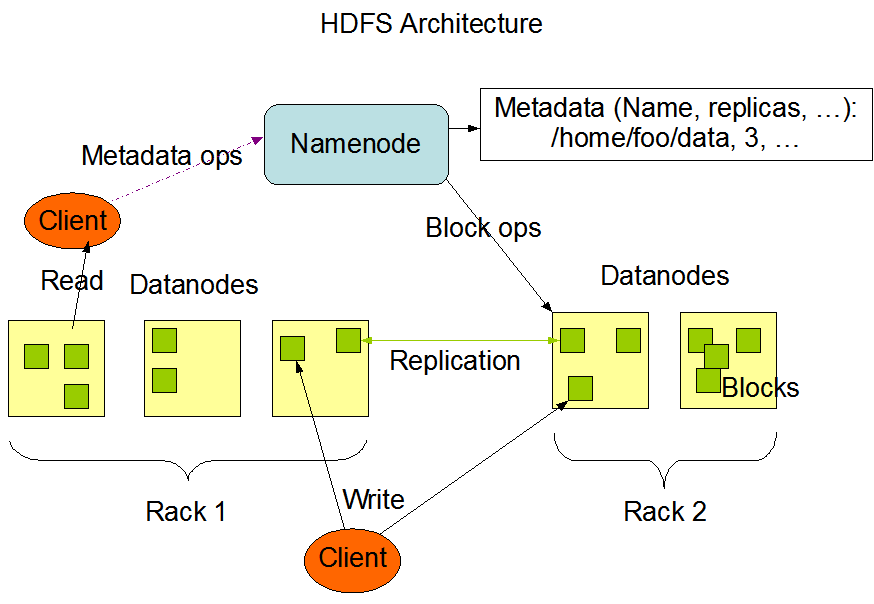
可以看到通信方面是有几个角色的:客户端(client)、NameNode、SecondaryNamenode、DataNode;其中SecondaryNamenode只与NameNode交互,其余的三种之间可以相互交互,所以便有了client—>NameNode,client—>DataNode,DataNode—>NameNode,DataNode—>DataNode,外加SecondaryNamenode<—>NameNode这几种交互方式,我们统一通过源码方式来先确定个大概轮廓。
其实在Hadoop中存在两种通信协议,一种是基于Hadoop RPC的,其实底层是用到了ProtoBuf,这个主要用于进程间的通信,是的进程间通信形同本地调用一样的;另一种时流式通信,毕竟Hadoop是用来存储文件的数据,这就需要流式方式来读写,因为文件不能中断具备连续性底层是基于Tcp来实现的。这篇文章主要还是在于介绍各类角色间的通信,属于进程间,所以主要还是RPC接口,当然具体实现后面开篇讲清楚,目前只是给个大概轮廓。
Hadoop RPC接口主要是定义在org.apache.hadoop.hdfs.server.protocol和org.apache.hadoop.hdfs.protocol两个包中。其中主要包括如下几个接口:
接下来一一介绍。
ClientProtocol定义了所有由客户端发起,由NameNode响应的操作。这个接口非常大,大概80几个方法:
/** * Licensed to the Apache Software Foundation (ASF) under one * or more contributor license agreements. See the NOTICE file * distributed with this work for additional information * regarding copyright ownership. The ASF licenses this file * to you under the Apache License, Version 2.0 (the * "License"); you may not use this file except in compliance * with the License. You may obtain a copy of the License at * * http://www.apache.org/licenses/LICENSE-2.0 * * Unless required by applicable law or agreed to in writing, software * distributed under the License is distributed on an "AS IS" BASIS, * WITHOUT WARRANTIES OR CONDITIONS OF ANY KIND, either express or implied. * See the License for the specific language governing permissions and * limitations under the License. */package org.apache.hadoop.hdfs.protocol;import java.io.IOException;import java.util.EnumSet;import java.util.List;import java.util.Map;import org.apache.hadoop.classification.InterfaceAudience;import org.apache.hadoop.classification.InterfaceStability;import org.apache.hadoop.crypto.CryptoProtocolVersion;import org.apache.hadoop.fs.BatchedRemoteIterator.BatchedEntries;import org.apache.hadoop.fs.PathIsNotEmptyDirectoryException;import org.apache.hadoop.ha.HAServiceProtocol;import org.apache.hadoop.hdfs.AddBlockFlag;import org.apache.hadoop.fs.CacheFlag;import org.apache.hadoop.fs.ContentSummary;import org.apache.hadoop.fs.CreateFlag;import org.apache.hadoop.fs.FsServerDefaults;import org.apache.hadoop.fs.Options;import org.apache.hadoop.fs.QuotaUsage;import org.apache.hadoop.fs.StorageType;import org.apache.hadoop.fs.XAttr;import org.apache.hadoop.fs.XAttrSetFlag;import org.apache.hadoop.fs.permission.AclEntry;import org.apache.hadoop.fs.permission.AclStatus;import org.apache.hadoop.fs.permission.FsAction;import org.apache.hadoop.fs.permission.FsPermission;import org.apache.hadoop.hdfs.inotify.EventBatchList;import org.apache.hadoop.hdfs.protocol.HdfsConstants.ReencryptAction;import org.apache.hadoop.hdfs.protocol.HdfsConstants.RollingUpgradeAction;import org.apache.hadoop.hdfs.protocol.OpenFilesIterator.OpenFilesType;import org.apache.hadoop.hdfs.security.token.block.DataEncryptionKey;import org.apache.hadoop.hdfs.security.token.delegation.DelegationTokenIdentifier;import org.apache.hadoop.hdfs.security.token.delegation.DelegationTokenSelector;import org.apache.hadoop.hdfs.server.namenode.ha.ReadOnly;import org.apache.hadoop.hdfs.server.protocol.DatanodeStorageReport;import org.apache.hadoop.io.EnumSetWritable;import org.apache.hadoop.io.Text;import org.apache.hadoop.io.retry.AtMostOnce;import org.apache.hadoop.io.retry.Idempotent;import org.apache.hadoop.security.AccessControlException;import org.apache.hadoop.security.KerberosInfo;import org.apache.hadoop.security.token.Token;import org.apache.hadoop.security.token.TokenInfo;import static org.apache.hadoop.hdfs.client.HdfsClientConfigKeys.DFS_NAMENODE_KERBEROS_PRINCIPAL_KEY;/********************************************************************** * ClientProtocol is used by user code via the DistributedFileSystem class to * communicate with the NameNode. User code can manipulate the directory * namespace, as well as open/close file streams, etc. * **********************************************************************/@InterfaceAudience.Private@InterfaceStability.Evolving@KerberosInfo( serverPrincipal = DFS_NAMENODE_KERBEROS_PRINCIPAL_KEY)@TokenInfo(DelegationTokenSelector.class)public interface ClientProtocol { /** * Until version 69, this class ClientProtocol served as both * the client interface to the NN AND the RPC protocol used to * communicate with the NN. * * This class is used by both the DFSClient and the * NN server side to insulate from the protocol serialization. * * If you are adding/changing this interface then you need to * change both this class and ALSO related protocol buffer * wire protocol definition in ClientNamenodeProtocol.proto. * * For more details on protocol buffer wire protocol, please see * .../org/apache/hadoop/hdfs/protocolPB/overview.html * * The log of historical changes can be retrieved from the svn). * 69: Eliminate overloaded method names. * * 69L is the last version id when this class was used for protocols * serialization. DO not update this version any further. */ long versionID = 69L; /////////////////////////////////////// // File contents /////////////////////////////////////// /** * Get locations of the blocks of the specified file * within the specified range. * DataNode locations for each block are sorted by * the proximity to the client. * <p> * Return {@link LocatedBlocks} which contains * file length, blocks and their locations. * DataNode locations for each block are sorted by * the distance to the client's address. * <p> * The client will then have to contact * one of the indicated DataNodes to obtain the actual data. * * @param src file name * @param offset range start offset * @param length range length * * @return file length and array of blocks with their locations * * @throws org.apache.hadoop.security.AccessControlException If access is * denied * @throws java.io.FileNotFoundException If file <code>src</code> does not * exist * @throws org.apache.hadoop.fs.UnresolvedLinkException If <code>src</code> * contains a symlink * @throws IOException If an I/O error occurred */ @Idempotent @ReadOnly(atimeAffected = true, isCoordinated = true) LocatedBlocks getBlockLocations(String src, long offset, long length) throws IOException; /** * Get server default values for a number of configuration params. * @return a set of server default configuration values * @throws IOException */ @Idempotent @ReadOnly(isCoordinated = true) FsServerDefaults getServerDefaults() throws IOException; /** * Create a new file entry in the namespace. * <p> * This will create an empty file specified by the source path. * The path should reflect a full path originated at the root. * The name-node does not have a notion of "current" directory for a client. * <p> * Once created, the file is visible and available for read to other clients. * Although, other clients cannot {@link #delete(String, boolean)}, re-create * or {@link #rename(String, String)} it until the file is completed * or explicitly as a result of lease expiration. * <p> * Blocks have a maximum size. Clients that intend to create * multi-block files must also use * {@link #addBlock} * * @param src path of the file being created. * @param masked masked permission. * @param clientName name of the current client. * @param flag indicates whether the file should be overwritten if it already * exists or create if it does not exist or append, or whether the * file should be a replicate file, no matter what its ancestor's * replication or erasure coding policy is. * @param createParent create missing parent directory if true * @param replication block replication factor. * @param blockSize maximum block size. * @param supportedVersions CryptoProtocolVersions supported by the client * @param ecPolicyName the name of erasure coding policy. A null value means * this file will inherit its parent directory's policy, * either traditional replication or erasure coding * policy. ecPolicyName and SHOULD_REPLICATE CreateFlag * are mutually exclusive. It's invalid to set both * SHOULD_REPLICATE flag and a non-null ecPolicyName. *@param storagePolicy the name of the storage policy. * * @return the status of the created file, it could be null if the server * doesn't support returning the file status * @throws org.apache.hadoop.security.AccessControlException If access is * denied * @throws AlreadyBeingCreatedException if the path does not exist. * @throws DSQuotaExceededException If file creation violates disk space * quota restriction * @throws org.apache.hadoop.fs.FileAlreadyExistsException If file * <code>src</code> already exists * @throws java.io.FileNotFoundException If parent of <code>src</code> does * not exist and <code>createParent</code> is false * @throws org.apache.hadoop.fs.ParentNotDirectoryException If parent of * <code>src</code> is not a directory. * @throws NSQuotaExceededException If file creation violates name space * quota restriction * @throws org.apache.hadoop.hdfs.server.namenode.SafeModeException create not * allowed in safemode * @throws org.apache.hadoop.fs.UnresolvedLinkException If <code>src</code> * contains a symlink * @throws SnapshotAccessControlException if path is in RO snapshot * @throws IOException If an I/O error occurred * * RuntimeExceptions: * @throws org.apache.hadoop.fs.InvalidPathException Path <code>src</code> is * invalid * <p> * <em>Note that create with {@link CreateFlag#OVERWRITE} is idempotent.</em> */ @AtMostOnce HdfsFileStatus create(String src, FsPermission masked, String clientName, EnumSetWritable<CreateFlag> flag, boolean createParent, short replication, long blockSize, CryptoProtocolVersion[] supportedVersions, String ecPolicyName, String storagePolicy) throws IOException; /** * Append to the end of the file. * @param src path of the file being created. * @param clientName name of the current client. * @param flag indicates whether the data is appended to a new block. * @return wrapper with information about the last partial block and file * status if any * @throws org.apache.hadoop.security.AccessControlException if permission to * append file is denied by the system. As usually on the client side the * exception will be wrapped into * {@link org.apache.hadoop.ipc.RemoteException}. * Allows appending to an existing file if the server is * configured with the parameter dfs.support.append set to true, otherwise * throws an IOException. * * @throws org.apache.hadoop.security.AccessControlException If permission to * append to file is denied * @throws java.io.FileNotFoundException If file <code>src</code> is not found * @throws DSQuotaExceededException If append violates disk space quota * restriction * @throws org.apache.hadoop.hdfs.server.namenode.SafeModeException append not * allowed in safemode * @throws org.apache.hadoop.fs.UnresolvedLinkException If <code>src</code> * contains a symlink * @throws SnapshotAccessControlException if path is in RO snapshot * @throws IOException If an I/O error occurred. * * RuntimeExceptions: * @throws UnsupportedOperationException if append is not supported */ @AtMostOnce LastBlockWithStatus append(String src, String clientName, EnumSetWritable<CreateFlag> flag) throws IOException; /** * Set replication for an existing file. * <p> * The NameNode sets replication to the new value and returns. * The actual block replication is not expected to be performed during * this method call. The blocks will be populated or removed in the * background as the result of the routine block maintenance procedures. * * @param src file name * @param replication new replication * * @return true if successful; * false if file does not exist or is a directory * * @throws org.apache.hadoop.security.AccessControlException If access is * denied * @throws DSQuotaExceededException If replication violates disk space * quota restriction * @throws java.io.FileNotFoundException If file <code>src</code> is not found * @throws org.apache.hadoop.hdfs.server.namenode.SafeModeException not * allowed in safemode * @throws org.apache.hadoop.fs.UnresolvedLinkException if <code>src</code> * contains a symlink * @throws SnapshotAccessControlException if path is in RO snapshot * @throws IOException If an I/O error occurred */ @Idempotent boolean setReplication(String src, short replication) throws IOException; /** * Get all the available block storage policies. * @return All the in-use block storage policies currently. */ @Idempotent @ReadOnly(isCoordinated = true) BlockStoragePolicy[] getStoragePolicies() throws IOException; /** * Set the storage policy for a file/directory. * @param src Path of an existing file/directory. * @param policyName The name of the storage policy * @throws SnapshotAccessControlException If access is denied * @throws org.apache.hadoop.fs.UnresolvedLinkException if <code>src</code> * contains a symlink * @throws java.io.FileNotFoundException If file/dir <code>src</code> is not * found * @throws QuotaExceededException If changes violate the quota restriction */ @Idempotent void setStoragePolicy(String src, String policyName) throws IOException; /** * Unset the storage policy set for a given file or directory. * @param src Path of an existing file/directory. * @throws SnapshotAccessControlException If access is denied * @throws org.apache.hadoop.fs.UnresolvedLinkException if <code>src</code> * contains a symlink * @throws java.io.FileNotFoundException If file/dir <code>src</code> is not * found * @throws QuotaExceededException If changes violate the quota restriction */ @Idempotent void unsetStoragePolicy(String src) throws IOException; /** * Get the storage policy for a file/directory. * @param path * Path of an existing file/directory. * @throws AccessControlException * If access is denied * @throws org.apache.hadoop.fs.UnresolvedLinkException * if <code>src</code> contains a symlink * @throws java.io.FileNotFoundException * If file/dir <code>src</code> is not found */ @Idempotent @ReadOnly(isCoordinated = true) BlockStoragePolicy getStoragePolicy(String path) throws IOException; /** * Set permissions for an existing file/directory. * * @throws org.apache.hadoop.security.AccessControlException If access is * denied * @throws java.io.FileNotFoundException If file <code>src</code> is not found * @throws org.apache.hadoop.hdfs.server.namenode.SafeModeException not * allowed in safemode * @throws org.apache.hadoop.fs.UnresolvedLinkException If <code>src</code> * contains a symlink * @throws SnapshotAccessControlException if path is in RO snapshot * @throws IOException If an I/O error occurred */ @Idempotent void setPermission(String src, FsPermission permission) throws IOException; /** * Set Owner of a path (i.e. a file or a directory). * The parameters username and groupname cannot both be null. * @param src file path * @param username If it is null, the original username remains unchanged. * @param groupname If it is null, the original groupname remains unchanged. * * @throws org.apache.hadoop.security.AccessControlException If access is * denied * @throws java.io.FileNotFoundException If file <code>src</code> is not found * @throws org.apache.hadoop.hdfs.server.namenode.SafeModeException not * allowed in safemode * @throws org.apache.hadoop.fs.UnresolvedLinkException If <code>src</code> * contains a symlink * @throws SnapshotAccessControlException if path is in RO snapshot * @throws IOException If an I/O error occurred */ @Idempotent void setOwner(String src, String username, String groupname) throws IOException; /** * The client can give up on a block by calling abandonBlock(). * The client can then either obtain a new block, or complete or abandon the * file. * Any partial writes to the block will be discarded. * * @param b Block to abandon * @param fileId The id of the file where the block resides. Older clients * will pass GRANDFATHER_INODE_ID here. * @param src The path of the file where the block resides. * @param holder Lease holder. * * @throws org.apache.hadoop.security.AccessControlException If access is * denied * @throws java.io.FileNotFoundException file <code>src</code> is not found * @throws org.apache.hadoop.fs.UnresolvedLinkException If <code>src</code> * contains a symlink * @throws IOException If an I/O error occurred */ @Idempotent void abandonBlock(ExtendedBlock b, long fileId, String src, String holder) throws IOException; /** * A client that wants to write an additional block to the * indicated filename (which must currently be open for writing) * should call addBlock(). * * addBlock() allocates a new block and datanodes the block data * should be replicated to. * * addBlock() also commits the previous block by reporting * to the name-node the actual generation stamp and the length * of the block that the client has transmitted to data-nodes. * * @param src the file being created * @param clientName the name of the client that adds the block * @param previous previous block * @param excludeNodes a list of nodes that should not be * allocated for the current block * @param fileId the id uniquely identifying a file * @param favoredNodes the list of nodes where the client wants the blocks. * Nodes are identified by either host name or address. * @param addBlockFlags flags to advise the behavior of allocating and placing * a new block. * * @return LocatedBlock allocated block information. * * @throws org.apache.hadoop.security.AccessControlException If access is * denied * @throws java.io.FileNotFoundException If file <code>src</code> is not found * @throws org.apache.hadoop.hdfs.server.namenode.NotReplicatedYetException * previous blocks of the file are not replicated yet. * Blocks cannot be added until replication completes. * @throws org.apache.hadoop.hdfs.server.namenode.SafeModeException create not * allowed in safemode * @throws org.apache.hadoop.fs.UnresolvedLinkException If <code>src</code> * contains a symlink * @throws IOException If an I/O error occurred */ @Idempotent LocatedBlock addBlock(String src, String clientName, ExtendedBlock previous, DatanodeInfo[] excludeNodes, long fileId, String[] favoredNodes, EnumSet<AddBlockFlag> addBlockFlags) throws IOException; /** * Get a datanode for an existing pipeline. * * @param src the file being written * @param fileId the ID of the file being written * @param blk the block being written * @param existings the existing nodes in the pipeline * @param excludes the excluded nodes * @param numAdditionalNodes number of additional datanodes * @param clientName the name of the client * * @return the located block. * * @throws org.apache.hadoop.security.AccessControlException If access is * denied * @throws java.io.FileNotFoundException If file <code>src</code> is not found * @throws org.apache.hadoop.hdfs.server.namenode.SafeModeException create not * allowed in safemode * @throws org.apache.hadoop.fs.UnresolvedLinkException If <code>src</code> * contains a symlink * @throws IOException If an I/O error occurred */ @Idempotent LocatedBlock getAdditionalDatanode(final String src, final long fileId, final ExtendedBlock blk, final DatanodeInfo[] existings, final String[] existingStorageIDs, final DatanodeInfo[] excludes, final int numAdditionalNodes, final String clientName ) throws IOException; /** * The client is done writing data to the given filename, and would * like to complete it. * * The function returns whether the file has been closed successfully. * If the function returns false, the caller should try again. * * close() also commits the last block of file by reporting * to the name-node the actual generation stamp and the length * of the block that the client has transmitted to data-nodes. * * A call to complete() will not return true until all the file's * blocks have been replicated the minimum number of times. Thus, * DataNode failures may cause a client to call complete() several * times before succeeding. * * @param src the file being created * @param clientName the name of the client that adds the block * @param last the last block info * @param fileId the id uniquely identifying a file * * @return true if all file blocks are minimally replicated or false otherwise * * @throws org.apache.hadoop.security.AccessControlException If access is * denied * @throws java.io.FileNotFoundException If file <code>src</code> is not found * @throws org.apache.hadoop.hdfs.server.namenode.SafeModeException create not * allowed in safemode * @throws org.apache.hadoop.fs.UnresolvedLinkException If <code>src</code> * contains a symlink * @throws IOException If an I/O error occurred */ @Idempotent boolean complete(String src, String clientName, ExtendedBlock last, long fileId) throws IOException; /** * The client wants to report corrupted blocks (blocks with specified * locations on datanodes). * @param blocks Array of located blocks to report */ @Idempotent void reportBadBlocks(LocatedBlock[] blocks) throws IOException; /////////////////////////////////////// // Namespace management /////////////////////////////////////// /** * Rename an item in the file system namespace. * @param src existing file or directory name. * @param dst new name. * @return true if successful, or false if the old name does not exist * or if the new name already belongs to the namespace. * * @throws SnapshotAccessControlException if path is in RO snapshot * @throws IOException an I/O error occurred */ @AtMostOnce boolean rename(String src, String dst) throws IOException; /** * Moves blocks from srcs to trg and delete srcs. * * @param trg existing file * @param srcs - list of existing files (same block size, same replication) * @throws IOException if some arguments are invalid * @throws org.apache.hadoop.fs.UnresolvedLinkException if <code>trg</code> or * <code>srcs</code> contains a symlink * @throws SnapshotAccessControlException if path is in RO snapshot */ @AtMostOnce void concat(String trg, String[] srcs) throws IOException; /** * Rename src to dst. * <ul> * <li>Fails if src is a file and dst is a directory. * <li>Fails if src is a directory and dst is a file. * <li>Fails if the parent of dst does not exist or is a file. * </ul> * <p> * Without OVERWRITE option, rename fails if the dst already exists. * With OVERWRITE option, rename overwrites the dst, if it is a file * or an empty directory. Rename fails if dst is a non-empty directory. * <p> * This implementation of rename is atomic. * <p> * @param src existing file or directory name. * @param dst new name. * @param options Rename options * * @throws org.apache.hadoop.security.AccessControlException If access is * denied * @throws DSQuotaExceededException If rename violates disk space * quota restriction * @throws org.apache.hadoop.fs.FileAlreadyExistsException If <code>dst</code> * already exists and <code>options</code> has * {@link org.apache.hadoop.fs.Options.Rename#OVERWRITE} option * false. * @throws java.io.FileNotFoundException If <code>src</code> does not exist * @throws NSQuotaExceededException If rename violates namespace * quota restriction * @throws org.apache.hadoop.fs.ParentNotDirectoryException If parent of * <code>dst</code> is not a directory * @throws org.apache.hadoop.hdfs.server.namenode.SafeModeException rename not * allowed in safemode * @throws org.apache.hadoop.fs.UnresolvedLinkException If <code>src</code> or * <code>dst</code> contains a symlink * @throws SnapshotAccessControlException if path is in RO snapshot * @throws IOException If an I/O error occurred */ @AtMostOnce void rename2(String src, String dst, Options.Rename... options) throws IOException; /** * Truncate file src to new size. * <ul> * <li>Fails if src is a directory. * <li>Fails if src does not exist. * <li>Fails if src is not closed. * <li>Fails if new size is greater than current size. * </ul> * <p> * This implementation of truncate is purely a namespace operation if truncate * occurs at a block boundary. Requires DataNode block recovery otherwise. * <p> * @param src existing file * @param newLength the target size * * @return true if client does not need to wait for block recovery, * false if client needs to wait for block recovery. * * @throws org.apache.hadoop.security.AccessControlException If access is * denied * @throws java.io.FileNotFoundException If file <code>src</code> is not found * @throws org.apache.hadoop.hdfs.server.namenode.SafeModeException truncate * not allowed in safemode * @throws org.apache.hadoop.fs.UnresolvedLinkException If <code>src</code> * contains a symlink * @throws SnapshotAccessControlException if path is in RO snapshot * @throws IOException If an I/O error occurred */ @Idempotent boolean truncate(String src, long newLength, String clientName) throws IOException; /** * Delete the given file or directory from the file system. * <p> * same as delete but provides a way to avoid accidentally * deleting non empty directories programmatically. * @param src existing name * @param recursive if true deletes a non empty directory recursively, * else throws an exception. * @return true only if the existing file or directory was actually removed * from the file system. * * @throws org.apache.hadoop.security.AccessControlException If access is * denied * @throws java.io.FileNotFoundException If file <code>src</code> is not found * @throws org.apache.hadoop.hdfs.server.namenode.SafeModeException create not * allowed in safemode * @throws org.apache.hadoop.fs.UnresolvedLinkException If <code>src</code> * contains a symlink * @throws SnapshotAccessControlException if path is in RO snapshot * @throws PathIsNotEmptyDirectoryException if path is a non-empty directory * and <code>recursive</code> is set to false * @throws IOException If an I/O error occurred */ @AtMostOnce boolean delete(String src, boolean recursive) throws IOException; /** * Create a directory (or hierarchy of directories) with the given * name and permission. * * @param src The path of the directory being created * @param masked The masked permission of the directory being created * @param createParent create missing parent directory if true * * @return True if the operation success. * * @throws org.apache.hadoop.security.AccessControlException If access is * denied * @throws org.apache.hadoop.fs.FileAlreadyExistsException If <code>src</code> * already exists * @throws java.io.FileNotFoundException If parent of <code>src</code> does * not exist and <code>createParent</code> is false * @throws NSQuotaExceededException If file creation violates quota * restriction * @throws org.apache.hadoop.fs.ParentNotDirectoryException If parent of * <code>src</code> is not a directory * @throws org.apache.hadoop.hdfs.server.namenode.SafeModeException create not * allowed in safemode * @throws org.apache.hadoop.fs.UnresolvedLinkException If <code>src</code> * contains a symlink * @throws SnapshotAccessControlException if path is in RO snapshot * @throws IOException If an I/O error occurred. * * RunTimeExceptions: * @throws org.apache.hadoop.fs.InvalidPathException If <code>src</code> is * invalid */ @Idempotent boolean mkdirs(String src, FsPermission masked, boolean createParent) throws IOException; /** * Get a partial listing of the indicated directory. * * @param src the directory name * @param startAfter the name to start listing after encoded in java UTF8 * @param needLocation if the FileStatus should contain block locations * * @return a partial listing starting after startAfter * * @throws org.apache.hadoop.security.AccessControlException permission denied * @throws java.io.FileNotFoundException file <code>src</code> is not found * @throws org.apache.hadoop.fs.UnresolvedLinkException If <code>src</code> * contains a symlink * @throws IOException If an I/O error occurred */ @Idempotent @ReadOnly(isCoordinated = true) DirectoryListing getListing(String src, byte[] startAfter, boolean needLocation) throws IOException; /** * Get a partial listing of the input directories * * @param srcs the input directories * @param startAfter the name to start listing after encoded in Java UTF8 * @param needLocation if the FileStatus should contain block locations * * @return a partial listing starting after startAfter. null if the input is * empty * @throws IOException if an I/O error occurred */ @Idempotent @ReadOnly(isCoordinated = true) BatchedDirectoryListing getBatchedListing( String[] srcs, byte[] startAfter, boolean needLocation) throws IOException; /** * Get the list of snapshottable directories that are owned * by the current user. Return all the snapshottable directories if the * current user is a super user. * @return The list of all the current snapshottable directories. * @throws IOException If an I/O error occurred. */ @Idempotent @ReadOnly(isCoordinated = true) SnapshottableDirectoryStatus[] getSnapshottableDirListing() throws IOException; /////////////////////////////////////// // System issues and management /////////////////////////////////////// /** * Client programs can cause stateful changes in the NameNode * that affect other clients. A client may obtain a file and * neither abandon nor complete it. A client might hold a series * of locks that prevent other clients from proceeding. * Clearly, it would be bad if a client held a bunch of locks * that it never gave up. This can happen easily if the client * dies unexpectedly. * <p> * So, the NameNode will revoke the locks and live file-creates * for clients that it thinks have died. A client tells the * NameNode that it is still alive by periodically calling * renewLease(). If a certain amount of time passes since * the last call to renewLease(), the NameNode assumes the * client has died. * * @throws org.apache.hadoop.security.AccessControlException permission denied * @throws IOException If an I/O error occurred */ @Idempotent void renewLease(String clientName) throws IOException; /** * Start lease recovery. * Lightweight NameNode operation to trigger lease recovery * * @param src path of the file to start lease recovery * @param clientName name of the current client * @return true if the file is already closed * @throws IOException */ @Idempotent boolean recoverLease(String src, String clientName) throws IOException; /** * Constants to index the array of aggregated stats returned by * {@link #getStats()}. */ int GET_STATS_CAPACITY_IDX = 0; int GET_STATS_USED_IDX = 1; int GET_STATS_REMAINING_IDX = 2; /** * Use {@link #GET_STATS_LOW_REDUNDANCY_IDX} instead. */ @Deprecated int GET_STATS_UNDER_REPLICATED_IDX = 3; int GET_STATS_LOW_REDUNDANCY_IDX = 3; int GET_STATS_CORRUPT_BLOCKS_IDX = 4; int GET_STATS_MISSING_BLOCKS_IDX = 5; int GET_STATS_MISSING_REPL_ONE_BLOCKS_IDX = 6; int GET_STATS_BYTES_IN_FUTURE_BLOCKS_IDX = 7; int GET_STATS_PENDING_DELETION_BLOCKS_IDX = 8; int STATS_ARRAY_LENGTH = 9; /** * Get an array of aggregated statistics combining blocks of both type * {@link BlockType#CONTIGUOUS} and {@link BlockType#STRIPED} in the * filesystem. Use public constants like {@link #GET_STATS_CAPACITY_IDX} in * place of actual numbers to index into the array. * <ul> * <li> [0] contains the total storage capacity of the system, in bytes.</li> * <li> [1] contains the total used space of the system, in bytes.</li> * <li> [2] contains the available storage of the system, in bytes.</li> * <li> [3] contains number of low redundancy blocks in the system.</li> * <li> [4] contains number of corrupt blocks. </li> * <li> [5] contains number of blocks without any good replicas left. </li> * <li> [6] contains number of blocks which have replication factor * 1 and have lost the only replica. </li> * <li> [7] contains number of bytes that are at risk for deletion. </li> * <li> [8] contains number of pending deletion blocks. </li> * </ul> */ @Idempotent @ReadOnly long[] getStats() throws IOException; /** * Get statistics pertaining to blocks of type {@link BlockType#CONTIGUOUS} * in the filesystem. */ @Idempotent @ReadOnly ReplicatedBlockStats getReplicatedBlockStats() throws IOException; /** * Get statistics pertaining to blocks of type {@link BlockType#STRIPED} * in the filesystem. */ @Idempotent @ReadOnly ECBlockGroupStats getECBlockGroupStats() throws IOException; /** * Get a report on the system's current datanodes. * One DatanodeInfo object is returned for each DataNode. * Return live datanodes if type is LIVE; dead datanodes if type is DEAD; * otherwise all datanodes if type is ALL. */ @Idempotent @ReadOnly DatanodeInfo[] getDatanodeReport(HdfsConstants.DatanodeReportType type) throws IOException; /** * Get a report on the current datanode storages. */ @Idempotent @ReadOnly DatanodeStorageReport[] getDatanodeStorageReport( HdfsConstants.DatanodeReportType type) throws IOException; /** * Get the block size for the given file. * @param filename The name of the file * @return The number of bytes in each block * @throws IOException * @throws org.apache.hadoop.fs.UnresolvedLinkException if the path contains * a symlink. */ @Idempotent @ReadOnly(isCoordinated = true) long getPreferredBlockSize(String filename) throws IOException; /** * Enter, leave or get safe mode. * <p> * Safe mode is a name node state when it * <ol><li>does not accept changes to name space (read-only), and</li> * <li>does not replicate or delete blocks.</li></ol> * * <p> * Safe mode is entered automatically at name node startup. * Safe mode can also be entered manually using * {@link #setSafeMode(HdfsConstants.SafeModeAction,boolean) * setSafeMode(SafeModeAction.SAFEMODE_ENTER,false)}. * <p> * At startup the name node accepts data node reports collecting * information about block locations. * In order to leave safe mode it needs to collect a configurable * percentage called threshold of blocks, which satisfy the minimal * replication condition. * The minimal replication condition is that each block must have at least * {@code dfs.namenode.replication.min} replicas. * When the threshold is reached the name node extends safe mode * for a configurable amount of time * to let the remaining data nodes to check in before it * will start replicating missing blocks. * Then the name node leaves safe mode. * <p> * If safe mode is turned on manually using * {@link #setSafeMode(HdfsConstants.SafeModeAction,boolean) * setSafeMode(SafeModeAction.SAFEMODE_ENTER,false)} * then the name node stays in safe mode until it is manually turned off * using {@link #setSafeMode(HdfsConstants.SafeModeAction,boolean) * setSafeMode(SafeModeAction.SAFEMODE_LEAVE,false)}. * Current state of the name node can be verified using * {@link #setSafeMode(HdfsConstants.SafeModeAction,boolean) * setSafeMode(SafeModeAction.SAFEMODE_GET,false)} * * <p><b>Configuration parameters:</b></p> * {@code dfs.safemode.threshold.pct} is the threshold parameter.<br> * {@code dfs.safemode.extension} is the safe mode extension parameter.<br> * {@code dfs.namenode.replication.min} is the minimal replication parameter. * * <p><b>Special cases:</b></p> * The name node does not enter safe mode at startup if the threshold is * set to 0 or if the name space is empty.<br> * If the threshold is set to 1 then all blocks need to have at least * minimal replication.<br> * If the threshold value is greater than 1 then the name node will not be * able to turn off safe mode automatically.<br> * Safe mode can always be turned off manually. * * @param action <ul> <li>0 leave safe mode;</li> * <li>1 enter safe mode;</li> * <li>2 get safe mode state.</li></ul> * @param isChecked If true then action will be done only in ActiveNN. * * @return <ul><li>0 if the safe mode is OFF or</li> * <li>1 if the safe mode is ON.</li></ul> * * @throws IOException */ @Idempotent boolean setSafeMode(HdfsConstants.SafeModeAction action, boolean isChecked) throws IOException; /** * Save namespace image. * <p> * Saves current namespace into storage directories and reset edits log. * Requires superuser privilege and safe mode. * * @param timeWindow NameNode does a checkpoint if the latest checkpoint was * done beyond the given time period (in seconds). * @param txGap NameNode does a checkpoint if the gap between the latest * checkpoint and the latest transaction id is greater this gap. * @return whether an extra checkpoint has been done * * @throws IOException if image creation failed. */ @AtMostOnce boolean saveNamespace(long timeWindow, long txGap) throws IOException; /** * Roll the edit log. * Requires superuser privileges. * * @throws org.apache.hadoop.security.AccessControlException if the superuser * privilege is violated * @throws IOException if log roll fails * @return the txid of the new segment */ @Idempotent long rollEdits() throws IOException; /** * Enable/Disable restore failed storage. * <p> * sets flag to enable restore of failed storage replicas * * @throws org.apache.hadoop.security.AccessControlException if the superuser * privilege is violated. */ @Idempotent boolean restoreFailedStorage(String arg) throws IOException; /** * Tells the namenode to reread the hosts and exclude files. * @throws IOException */ @Idempotent void refreshNodes() throws IOException; /** * Finalize previous upgrade. * Remove file system state saved during the upgrade. * The upgrade will become irreversible. * * @throws IOException */ @Idempotent void finalizeUpgrade() throws IOException; /** * Get status of upgrade - finalized or not. * @return true if upgrade is finalized or if no upgrade is in progress and * false otherwise. * @throws IOException */ @Idempotent boolean upgradeStatus() throws IOException; /** * Rolling upgrade operations. * @param action either query, prepare or finalize. * @return rolling upgrade information. On query, if no upgrade is in * progress, returns null. */ @Idempotent RollingUpgradeInfo rollingUpgrade(RollingUpgradeAction action) throws IOException; /** * @return CorruptFileBlocks, containing a list of corrupt files (with * duplicates if there is more than one corrupt block in a file) * and a cookie * @throws IOException * * Each call returns a subset of the corrupt files in the system. To obtain * all corrupt files, call this method repeatedly and each time pass in the * cookie returned from the previous call. */ @Idempotent @ReadOnly(isCoordinated = true) CorruptFileBlocks listCorruptFileBlocks(String path, String cookie) throws IOException; /** * Dumps namenode data structures into specified file. If the file * already exists, then append. * * @throws IOException */ @Idempotent void metaSave(String filename) throws IOException; /** * Tell all datanodes to use a new, non-persistent bandwidth value for * dfs.datanode.balance.bandwidthPerSec. * * @param bandwidth Blanacer bandwidth in bytes per second for this datanode. * @throws IOException */ @Idempotent void setBalancerBandwidth(long bandwidth) throws IOException; /** * Get the file info for a specific file or directory. * @param src The string representation of the path to the file * * @return object containing information regarding the file * or null if file not found * @throws org.apache.hadoop.security.AccessControlException permission denied * @throws java.io.FileNotFoundException file <code>src</code> is not found * @throws org.apache.hadoop.fs.UnresolvedLinkException if the path contains * a symlink. * @throws IOException If an I/O error occurred */ @Idempotent @ReadOnly(isCoordinated = true) HdfsFileStatus getFileInfo(String src) throws IOException; /** * Get the close status of a file. * @param src The string representation of the path to the file * * @return return true if file is closed * @throws org.apache.hadoop.security.AccessControlException permission denied * @throws java.io.FileNotFoundException file <code>src</code> is not found * @throws org.apache.hadoop.fs.UnresolvedLinkException if the path contains * a symlink. * @throws IOException If an I/O error occurred */ @Idempotent @ReadOnly(isCoordinated = true) boolean isFileClosed(String src) throws IOException; /** * Get the file info for a specific file or directory. If the path * refers to a symlink then the FileStatus of the symlink is returned. * @param src The string representation of the path to the file * * @return object containing information regarding the file * or null if file not found * * @throws org.apache.hadoop.security.AccessControlException permission denied * @throws org.apache.hadoop.fs.UnresolvedLinkException if <code>src</code> * contains a symlink * @throws IOException If an I/O error occurred */ @Idempotent @ReadOnly(isCoordinated = true) HdfsFileStatus getFileLinkInfo(String src) throws IOException; /** * Get the file info for a specific file or directory with * {@link LocatedBlocks}. * @param src The string representation of the path to the file * @param needBlockToken Generate block tokens for {@link LocatedBlocks} * @return object containing information regarding the file * or null if file not found * @throws org.apache.hadoop.security.AccessControlException permission denied * @throws java.io.FileNotFoundException file <code>src</code> is not found * @throws IOException If an I/O error occurred */ @Idempotent @ReadOnly(isCoordinated = true) HdfsLocatedFileStatus getLocatedFileInfo(String src, boolean needBlockToken) throws IOException; /** * Get {@link ContentSummary} rooted at the specified directory. * @param path The string representation of the path * * @throws org.apache.hadoop.security.AccessControlException permission denied * @throws java.io.FileNotFoundException file <code>path</code> is not found * @throws org.apache.hadoop.fs.UnresolvedLinkException if <code>path</code> * contains a symlink. * @throws IOException If an I/O error occurred */ @Idempotent @ReadOnly(isCoordinated = true) ContentSummary getContentSummary(String path) throws IOException; /** * Set the quota for a directory. * @param path The string representation of the path to the directory * @param namespaceQuota Limit on the number of names in the tree rooted * at the directory * @param storagespaceQuota Limit on storage space occupied all the files * under this directory. * @param type StorageType that the space quota is intended to be set on. * It may be null when called by traditional space/namespace * quota. When type is is not null, the storagespaceQuota * parameter is for type specified and namespaceQuota must be * {@link HdfsConstants#QUOTA_DONT_SET}. * * <br><br> * * The quota can have three types of values : (1) 0 or more will set * the quota to that value, (2) {@link HdfsConstants#QUOTA_DONT_SET} implies * the quota will not be changed, and (3) {@link HdfsConstants#QUOTA_RESET} * implies the quota will be reset. Any other value is a runtime error. * * @throws org.apache.hadoop.security.AccessControlException permission denied * @throws java.io.FileNotFoundException file <code>path</code> is not found * @throws QuotaExceededException if the directory size * is greater than the given quota * @throws org.apache.hadoop.fs.UnresolvedLinkException if the * <code>path</code> contains a symlink. * @throws SnapshotAccessControlException if path is in RO snapshot * @throws IOException If an I/O error occurred */ @Idempotent void setQuota(String path, long namespaceQuota, long storagespaceQuota, StorageType type) throws IOException; /** * Write all metadata for this file into persistent storage. * The file must be currently open for writing. * @param src The string representation of the path * @param inodeId The inode ID, or GRANDFATHER_INODE_ID if the client is * too old to support fsync with inode IDs. * @param client The string representation of the client * @param lastBlockLength The length of the last block (under construction) * to be reported to NameNode * @throws org.apache.hadoop.security.AccessControlException permission denied * @throws java.io.FileNotFoundException file <code>src</code> is not found * @throws org.apache.hadoop.fs.UnresolvedLinkException if <code>src</code> * contains a symlink. * @throws IOException If an I/O error occurred */ @Idempotent void fsync(String src, long inodeId, String client, long lastBlockLength) throws IOException; /** * Sets the modification and access time of the file to the specified time. * @param src The string representation of the path * @param mtime The number of milliseconds since Jan 1, 1970. * Setting negative mtime means that modification time should not * be set by this call. * @param atime The number of milliseconds since Jan 1, 1970. * Setting negative atime means that access time should not be * set by this call. * * @throws org.apache.hadoop.security.AccessControlException permission denied * @throws java.io.FileNotFoundException file <code>src</code> is not found * @throws org.apache.hadoop.fs.UnresolvedLinkException if <code>src</code> * contains a symlink. * @throws SnapshotAccessControlException if path is in RO snapshot * @throws IOException If an I/O error occurred */ @Idempotent void setTimes(String src, long mtime, long atime) throws IOException; /** * Create symlink to a file or directory. * @param target The path of the destination that the * link points to. * @param link The path of the link being created. * @param dirPerm permissions to use when creating parent directories * @param createParent - if true then missing parent dirs are created * if false then parent must exist * * @throws org.apache.hadoop.security.AccessControlException permission denied * @throws org.apache.hadoop.fs.FileAlreadyExistsException If file * <code>link</code> already exists * @throws java.io.FileNotFoundException If parent of <code>link</code> does * not exist and <code>createParent</code> is false * @throws org.apache.hadoop.fs.ParentNotDirectoryException If parent of * <code>link</code> is not a directory. * @throws org.apache.hadoop.fs.UnresolvedLinkException if <code>link</code> * contains a symlink. * @throws SnapshotAccessControlException if path is in RO snapshot * @throws IOException If an I/O error occurred */ @AtMostOnce void createSymlink(String target, String link, FsPermission dirPerm, boolean createParent) throws IOException; /** * Return the target of the given symlink. If there is an intermediate * symlink in the path (ie a symlink leading up to the final path component) * then the given path is returned with this symlink resolved. * * @param path The path with a link that needs resolution. * @return The path after resolving the first symbolic link in the path. * @throws org.apache.hadoop.security.AccessControlException permission denied * @throws java.io.FileNotFoundException If <code>path</code> does not exist * @throws IOException If the given path does not refer to a symlink * or an I/O error occurred */ @Idempotent @ReadOnly(isCoordinated = true) String getLinkTarget(String path) throws IOException; /** * Get a new generation stamp together with an access token for * a block under construction * * This method is called only when a client needs to recover a failed * pipeline or set up a pipeline for appending to a block. * * @param block a block * @param clientName the name of the client * @return a located block with a new generation stamp and an access token * @throws IOException if any error occurs */ @Idempotent LocatedBlock updateBlockForPipeline(ExtendedBlock block, String clientName) throws IOException; /** * Update a pipeline for a block under construction. * * @param clientName the name of the client * @param oldBlock the old block * @param newBlock the new block containing new generation stamp and length * @param newNodes datanodes in the pipeline * @throws IOException if any error occurs */ @AtMostOnce void updatePipeline(String clientName, ExtendedBlock oldBlock, ExtendedBlock newBlock, DatanodeID[] newNodes, String[] newStorageIDs) throws IOException; /** * Get a valid Delegation Token. * * @param renewer the designated renewer for the token * @throws IOException */ @Idempotent Token<DelegationTokenIdentifier> getDelegationToken(Text renewer) throws IOException; /** * Renew an existing delegation token. * * @param token delegation token obtained earlier * @return the new expiration time * @throws IOException */ @Idempotent long renewDelegationToken(Token<DelegationTokenIdentifier> token) throws IOException; /** * Cancel an existing delegation token. * * @param token delegation token * @throws IOException */ @Idempotent void cancelDelegationToken(Token<DelegationTokenIdentifier> token) throws IOException; /** * @return encryption key so a client can encrypt data sent via the * DataTransferProtocol to/from DataNodes. * @throws IOException */ @Idempotent @ReadOnly(isCoordinated = true) DataEncryptionKey getDataEncryptionKey() throws IOException; /** * Create a snapshot. * @param snapshotRoot the path that is being snapshotted * @param snapshotName name of the snapshot created * @return the snapshot path. * @throws IOException */ @AtMostOnce String createSnapshot(String snapshotRoot, String snapshotName) throws IOException; /** * Delete a specific snapshot of a snapshottable directory. * @param snapshotRoot The snapshottable directory * @param snapshotName Name of the snapshot for the snapshottable directory * @throws IOException */ @AtMostOnce void deleteSnapshot(String snapshotRoot, String snapshotName) throws IOException; /** * Rename a snapshot. * @param snapshotRoot the directory path where the snapshot was taken * @param snapshotOldName old name of the snapshot * @param snapshotNewName new name of the snapshot * @throws IOException */ @AtMostOnce void renameSnapshot(String snapshotRoot, String snapshotOldName, String snapshotNewName) throws IOException; /** * Allow snapshot on a directory. * @param snapshotRoot the directory to be snapped * @throws IOException on error */ @Idempotent void allowSnapshot(String snapshotRoot) throws IOException; /** * Disallow snapshot on a directory. * @param snapshotRoot the directory to disallow snapshot * @throws IOException on error */ @Idempotent void disallowSnapshot(String snapshotRoot) throws IOException; /** * Get the difference between two snapshots, or between a snapshot and the * current tree of a directory. * * @param snapshotRoot * full path of the directory where snapshots are taken * @param fromSnapshot * snapshot name of the from point. Null indicates the current * tree * @param toSnapshot * snapshot name of the to point. Null indicates the current * tree. * @return The difference report represented as a {@link SnapshotDiffReport}. * @throws IOException on error */ @Idempotent @ReadOnly(isCoordinated = true) SnapshotDiffReport getSnapshotDiffReport(String snapshotRoot, String fromSnapshot, String toSnapshot) throws IOException; /** * Get the difference between two snapshots of a directory iteratively. * * @param snapshotRoot * full path of the directory where snapshots are taken * @param fromSnapshot * snapshot name of the from point. Null indicates the current * tree * @param toSnapshot * snapshot name of the to point. Null indicates the current * tree. * @param startPath * path relative to the snapshottable root directory from where the * snapshotdiff computation needs to start across multiple rpc calls * @param index * index in the created or deleted list of the directory at which * the snapshotdiff computation stopped during the last rpc call * as the no of entries exceeded the snapshotdiffentry limit. -1 * indicates, the snapshotdiff compuatation needs to start right * from the startPath provided. * @return The difference report represented as a {@link SnapshotDiffReport}. * @throws IOException on error */ @Idempotent @ReadOnly(isCoordinated = true) SnapshotDiffReportListing getSnapshotDiffReportListing(String snapshotRoot, String fromSnapshot, String toSnapshot, byte[] startPath, int index) throws IOException; /** * Add a CacheDirective to the CacheManager. * * @param directive A CacheDirectiveInfo to be added * @param flags {@link CacheFlag}s to use for this operation. * @return A CacheDirectiveInfo associated with the added directive * @throws IOException if the directive could not be added */ @AtMostOnce long addCacheDirective(CacheDirectiveInfo directive, EnumSet<CacheFlag> flags) throws IOException; /** * Modify a CacheDirective in the CacheManager. * * @param flags {@link CacheFlag}s to use for this operation. * @throws IOException if the directive could not be modified */ @AtMostOnce void modifyCacheDirective(CacheDirectiveInfo directive, EnumSet<CacheFlag> flags) throws IOException; /** * Remove a CacheDirectiveInfo from the CacheManager. * * @param id of a CacheDirectiveInfo * @throws IOException if the cache directive could not be removed */ @AtMostOnce void removeCacheDirective(long id) throws IOException; /** * List the set of cached paths of a cache pool. Incrementally fetches results * from the server. * * @param prevId The last listed entry ID, or -1 if this is the first call to * listCacheDirectives. * @param filter Parameters to use to filter the list results, * or null to display all directives visible to us. * @return A batch of CacheDirectiveEntry objects. */ @Idempotent @ReadOnly(isCoordinated = true) BatchedEntries<CacheDirectiveEntry> listCacheDirectives( long prevId, CacheDirectiveInfo filter) throws IOException; /** * Add a new cache pool. * * @param info Description of the new cache pool * @throws IOException If the request could not be completed. */ @AtMostOnce void addCachePool(CachePoolInfo info) throws IOException; /** * Modify an existing cache pool. * * @param req * The request to modify a cache pool. * @throws IOException * If the request could not be completed. */ @AtMostOnce void modifyCachePool(CachePoolInfo req) throws IOException; /** * Remove a cache pool. * * @param pool name of the cache pool to remove. * @throws IOException if the cache pool did not exist, or could not be * removed. */ @AtMostOnce void removeCachePool(String pool) throws IOException; /** * List the set of cache pools. Incrementally fetches results from the server. * * @param prevPool name of the last pool listed, or the empty string if this * is the first invocation of listCachePools * @return A batch of CachePoolEntry objects. */ @Idempotent @ReadOnly(isCoordinated = true) BatchedEntries<CachePoolEntry> listCachePools(String prevPool) throws IOException; /** * Modifies ACL entries of files and directories. This method can add new ACL * entries or modify the permissions on existing ACL entries. All existing * ACL entries that are not specified in this call are retained without * changes. (Modifications are merged into the current ACL.) */ @Idempotent void modifyAclEntries(String src, List<AclEntry> aclSpec) throws IOException; /** * Removes ACL entries from files and directories. Other ACL entries are * retained. */ @Idempotent void removeAclEntries(String src, List<AclEntry> aclSpec) throws IOException; /** * Removes all default ACL entries from files and directories. */ @Idempotent void removeDefaultAcl(String src) throws IOException; /** * Removes all but the base ACL entries of files and directories. The entries * for user, group, and others are retained for compatibility with permission * bits. */ @Idempotent void removeAcl(String src) throws IOException; /** * Fully replaces ACL of files and directories, discarding all existing * entries. */ @Idempotent void setAcl(String src, List<AclEntry> aclSpec) throws IOException; /** * Gets the ACLs of files and directories. */ @Idempotent @ReadOnly(isCoordinated = true) AclStatus getAclStatus(String src) throws IOException; /** * Create an encryption zone. */ @AtMostOnce void createEncryptionZone(String src, String keyName) throws IOException; /** * Get the encryption zone for a path. */ @Idempotent @ReadOnly(isCoordinated = true) EncryptionZone getEZForPath(String src) throws IOException; /** * Used to implement cursor-based batched listing of {@link EncryptionZone}s. * * @param prevId ID of the last item in the previous batch. If there is no * previous batch, a negative value can be used. * @return Batch of encryption zones. */ @Idempotent @ReadOnly(isCoordinated = true) BatchedEntries<EncryptionZone> listEncryptionZones( long prevId) throws IOException; /** * Used to implement re-encryption of encryption zones. * * @param zone the encryption zone to re-encrypt. * @param action the action for the re-encryption. * @throws IOException */ @AtMostOnce void reencryptEncryptionZone(String zone, ReencryptAction action) throws IOException; /** * Used to implement cursor-based batched listing of * {@link ZoneReencryptionStatus}s. * * @param prevId ID of the last item in the previous batch. If there is no * previous batch, a negative value can be used. * @return Batch of encryption zones. * @throws IOException */ @Idempotent @ReadOnly(isCoordinated = true) BatchedEntries<ZoneReencryptionStatus> listReencryptionStatus(long prevId) throws IOException; /** * Set xattr of a file or directory. * The name must be prefixed with the namespace followed by ".". For example, * "user.attr". * <p> * Refer to the HDFS extended attributes user documentation for details. * * @param src file or directory * @param xAttr <code>XAttr</code> to set * @param flag set flag * @throws IOException */ @AtMostOnce void setXAttr(String src, XAttr xAttr, EnumSet<XAttrSetFlag> flag) throws IOException; /** * Get xattrs of a file or directory. Values in xAttrs parameter are ignored. * If xAttrs is null or empty, this is the same as getting all xattrs of the * file or directory. Only those xattrs for which the logged-in user has * permissions to view are returned. * <p> * Refer to the HDFS extended attributes user documentation for details. * * @param src file or directory * @param xAttrs xAttrs to get * @return <code>XAttr</code> list * @throws IOException */ @Idempotent @ReadOnly(isCoordinated = true) List<XAttr> getXAttrs(String src, List<XAttr> xAttrs) throws IOException; /** * List the xattrs names for a file or directory. * Only the xattr names for which the logged in user has the permissions to * access will be returned. * <p> * Refer to the HDFS extended attributes user documentation for details. * * @param src file or directory * @return <code>XAttr</code> list * @throws IOException */ @Idempotent @ReadOnly(isCoordinated = true) List<XAttr> listXAttrs(String src) throws IOException; /** * Remove xattr of a file or directory.Value in xAttr parameter is ignored. * The name must be prefixed with the namespace followed by ".". For example, * "user.attr". * <p> * Refer to the HDFS extended attributes user documentation for details. * * @param src file or directory * @param xAttr <code>XAttr</code> to remove * @throws IOException */ @AtMostOnce void removeXAttr(String src, XAttr xAttr) throws IOException; /** * Checks if the user can access a path. The mode specifies which access * checks to perform. If the requested permissions are granted, then the * method returns normally. If access is denied, then the method throws an * {@link org.apache.hadoop.security.AccessControlException}. * In general, applications should avoid using this method, due to the risk of * time-of-check/time-of-use race conditions. The permissions on a file may * change immediately after the access call returns. * * @param path Path to check * @param mode type of access to check * @throws org.apache.hadoop.security.AccessControlException if access is * denied * @throws java.io.FileNotFoundException if the path does not exist * @throws IOException see specific implementation */ @Idempotent @ReadOnly(isCoordinated = true) void checkAccess(String path, FsAction mode) throws IOException; /** * Get the highest txid the NameNode knows has been written to the edit * log, or -1 if the NameNode's edit log is not yet open for write. Used as * the starting point for the inotify event stream. */ @Idempotent @ReadOnly(isCoordinated = true) long getCurrentEditLogTxid() throws IOException; /** * Get an ordered list of batches of events corresponding to the edit log * transactions for txids equal to or greater than txid. */ @Idempotent @ReadOnly(isCoordinated = true) EventBatchList getEditsFromTxid(long txid) throws IOException; /** * Set an erasure coding policy on a specified path. * @param src The path to set policy on. * @param ecPolicyName The erasure coding policy name. */ @AtMostOnce void setErasureCodingPolicy(String src, String ecPolicyName) throws IOException; /** * Add Erasure coding policies to HDFS. For each policy input, schema and * cellSize are musts, name and id are ignored. They will be automatically * created and assigned by Namenode once the policy is successfully added, and * will be returned in the response. * * @param policies The user defined ec policy list to add. * @return Return the response list of adding operations. * @throws IOException */ @AtMostOnce AddErasureCodingPolicyResponse[] addErasureCodingPolicies( ErasureCodingPolicy[] policies) throws IOException; /** * Remove erasure coding policy. * @param ecPolicyName The name of the policy to be removed. * @throws IOException */ @AtMostOnce void removeErasureCodingPolicy(String ecPolicyName) throws IOException; /** * Enable erasure coding policy. * @param ecPolicyName The name of the policy to be enabled. * @throws IOException */ @AtMostOnce void enableErasureCodingPolicy(String ecPolicyName) throws IOException; /** * Disable erasure coding policy. * @param ecPolicyName The name of the policy to be disabled. * @throws IOException */ @AtMostOnce void disableErasureCodingPolicy(String ecPolicyName) throws IOException; /** * Get the erasure coding policies loaded in Namenode, excluding REPLICATION * policy. * * @throws IOException */ @Idempotent @ReadOnly(isCoordinated = true) ErasureCodingPolicyInfo[] getErasureCodingPolicies() throws IOException; /** * Get the erasure coding codecs loaded in Namenode. * * @throws IOException */ @Idempotent @ReadOnly(isCoordinated = true) Map<String, String> getErasureCodingCodecs() throws IOException; /** * Get the information about the EC policy for the path. Null will be returned * if directory or file has REPLICATION policy. * * @param src path to get the info for * @throws IOException */ @Idempotent @ReadOnly(isCoordinated = true) ErasureCodingPolicy getErasureCodingPolicy(String src) throws IOException; /** * Unset erasure coding policy from a specified path. * @param src The path to unset policy. */ @AtMostOnce void unsetErasureCodingPolicy(String src) throws IOException; /** * Verifies if the given policies are supported in the given cluster setup. * If not policy is specified checks for all enabled policies. * @param policyNames name of policies. * @return the result if the given policies are supported in the cluster setup * @throws IOException */ @Idempotent @ReadOnly ECTopologyVerifierResult getECTopologyResultForPolicies(String... policyNames) throws IOException; /** * Get {@link QuotaUsage} rooted at the specified directory. * * Note: due to HDFS-6763, standby/observer doesn't keep up-to-date info * about quota usage, and thus even though this is ReadOnly, it can only be * directed to the active namenode. * * @param path The string representation of the path * * @throws AccessControlException permission denied * @throws java.io.FileNotFoundException file <code>path</code> is not found * @throws org.apache.hadoop.fs.UnresolvedLinkException if <code>path</code> * contains a symlink. * @throws IOException If an I/O error occurred */ @Idempotent @ReadOnly(activeOnly = true) QuotaUsage getQuotaUsage(String path) throws IOException; /** * List open files in the system in batches. INode id is the cursor and the * open files returned in a batch will have their INode ids greater than * the cursor INode id. Open files can only be requested by super user and * the the list across batches are not atomic. * * @param prevId the cursor INode id. * @throws IOException */ @Idempotent @Deprecated @ReadOnly(isCoordinated = true) BatchedEntries<OpenFileEntry> listOpenFiles(long prevId) throws IOException; /** * List open files in the system in batches. INode id is the cursor and the * open files returned in a batch will have their INode ids greater than * the cursor INode id. Open files can only be requested by super user and * the the list across batches are not atomic. * * @param prevId the cursor INode id. * @param openFilesTypes types to filter the open files. * @param path path to filter the open files. * @throws IOException */ @Idempotent @ReadOnly(isCoordinated = true) BatchedEntries<OpenFileEntry> listOpenFiles(long prevId, EnumSet<OpenFilesType> openFilesTypes, String path) throws IOException; /** * Get HA service state of the server. * * @return server HA state * @throws IOException */ @Idempotent @ReadOnly HAServiceProtocol.HAServiceState getHAServiceState() throws IOException; /** * Called by client to wait until the server has reached the state id of the * client. The client and server state id are given by client side and server * side alignment context respectively. This can be a blocking call. * * @throws IOException */ @Idempotent @ReadOnly(activeOnly = true) void msync() throws IOException; /** * Satisfy the storage policy for a file/directory. * @param path Path of an existing file/directory. * @throws AccessControlException If access is denied. * @throws org.apache.hadoop.fs.UnresolvedLinkException if <code>src</code> * contains a symlink. * @throws java.io.FileNotFoundException If file/dir <code>src</code> is not * found. * @throws org.apache.hadoop.hdfs.server.namenode.SafeModeException append not * allowed in safemode. */ @AtMostOnce void satisfyStoragePolicy(String path) throws IOException;}这么多方法我们是无法一一分析的,我们可以分下类:
ClientProtocol中与客户端读取文件相关的方法有两个:getBlockLocations()和reportBadBlocks()。
getBlockLocations()方法可以获取HDFS文件执行范围内所有数据块的位置信息,这个方法的参数是HDFS文件的文件名以及读取范围,返回值是文件指定范围内所有数据块的文件名以及它们的位置信息,使用了LocatedBlocks对象来封装。每个数据块的位置信息指的是存储这个数据块副本的所有DataNode的信息,这些DataNode会以与当前客户端的距离远近排序。在读取到位置信息后,在从返回的数据节点读取真正的信息:
@Idempotent @ReadOnly(atimeAffected = true, isCoordinated = true) LocatedBlocks getBlockLocations(String src, long offset, long length) throws IOException;客户端会调用reportBadBlocks()方法向NameNode汇报错误的数据块,当客户端从数据节点读取数据块且发现数据块的校验和不正确时,就会调用这个方法向NameNode汇报这个错误的数据块信息:
@Idempotent void reportBadBlocks(LocatedBlock[] blocks) throws IOException;在HDFS客户端操作中最重要的一个部分就是写入一个新的HDFS文件,或者打开一个已有的HDFS文件并执行追加写操作。ClientProtocol里面定义了8个通俗易懂的方法支持HDFS文件的写操作:create()、append()、addBlock、complete()、abandonBlock()、getAddtionnalDatanodes()、updateBlockForPipeline()和updatePipeline()。